
Overhang distorts path to power
The official results of the 2026 General Election confirm 10 overhang seats. The popular vote gave Labour, the Greens, Te Pāti Māori and Opportunity 61 of 120 votes, a majority; the overhang turns it into a tie. SaveMMP asks the new Parliament to fix the rule this term, protect the fix, and make it easy to vote.
The official results of the 2026 General Election, declared today by the Electoral Commission, confirm 10 overhang seats, the largest overhang since MMP began. Parliament will have 130 members in place of 120. On the popular vote, Labour, the Greens, Te Pāti Māori and Opportunity together earned 61 of 120 votes, a majority and an opportunity to govern. In the House of 130 the same parties hold 65, a tie. The official results are subject to any applications for judicial recounts.
How the path to power changes
The party vote is the popular vote. The two graphs show what it earned each party, and what the House holds.
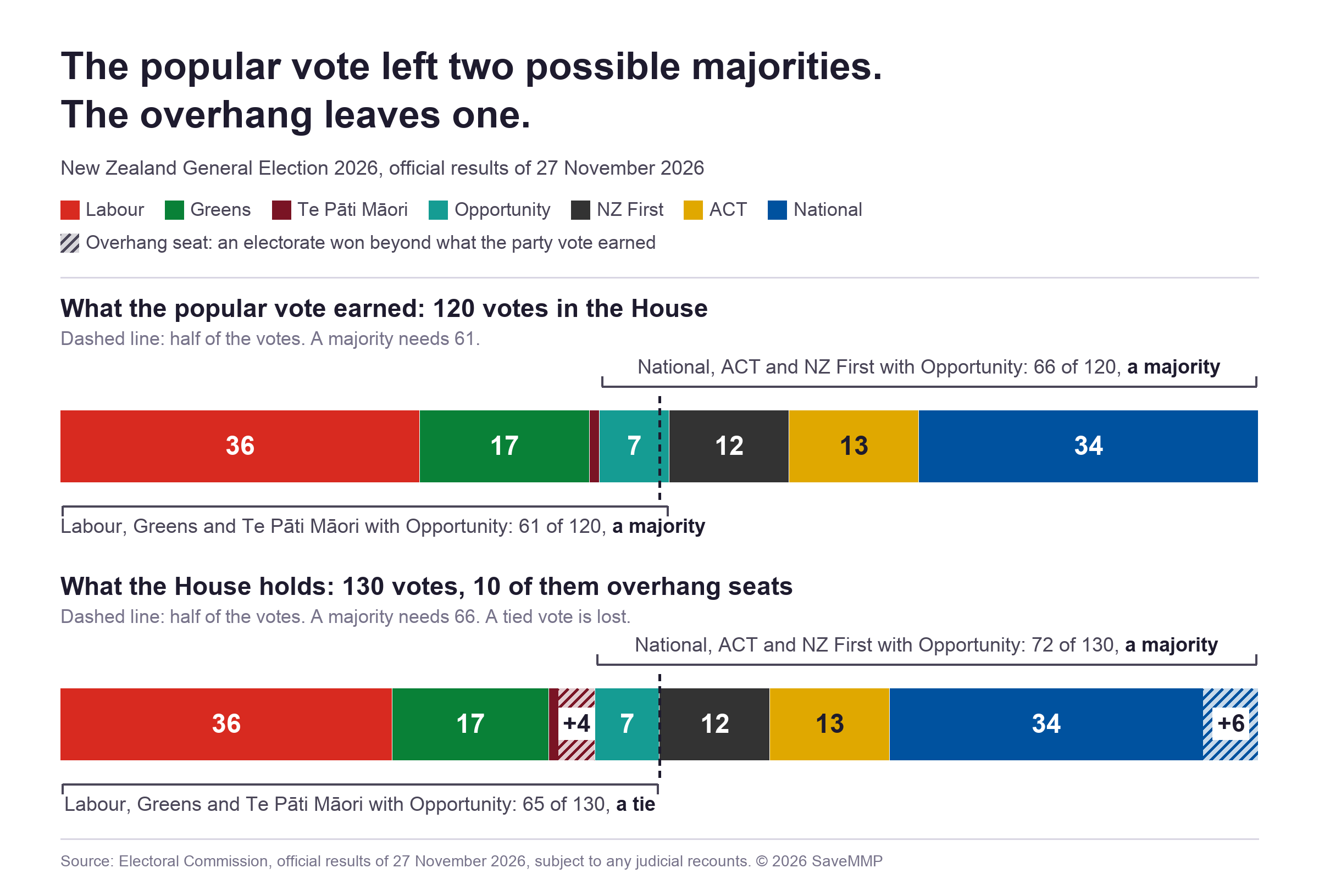
On the popular vote, Opportunity could form a majority with either group. With the overhang only one of the two is a majority. The other is a hung Parliament, 65 against 65.
On that basis SaveMMP argues that the overhang decides who is able to form a government. SaveMMP sees this as a distortion of the result of the election, shown by the official results themselves.
SaveMMP says this is a fault in the rules and not a charge against any party. Both sides of the House hold overhang seats, and every party acted within the law.
“The party vote is the popular vote. On today’s official results it left two possible majorities, and the 10 overhang seats took one of them away. The overhang decides who is able to form a government, and that distorts the result of the election. We do not say who should govern. We say that votes in Parliament should come from the party vote alone.”
What the party vote earned, and what the House holds
New Zealanders cast 2,888,890 valid party votes. Those votes share out 120 votes in the House. The overhang adds 10 more that no party vote earned.
Two parties hold the 10 overhang seats.
- National holds 6. Its party vote earned it 34 seats, and it won 40 electorates.
- Te Pāti Māori holds 4. Its party vote earned it 1 seat, and it won 5 electorates.
No other party holds an overhang seat. Both parties keep every electorate they won, as the law provides.
So the overhang sits on both sides of the House, but not evenly. Six overhang seats are with National, ACT and New Zealand First. Four are with Labour, the Greens and Te Pāti Māori.
Three asks of the new Parliament
- Fix it. Pass the rule this term, in time for the 2029 election.
- Protect it. Entrench it, so that it can be changed only by three-quarters of all MPs, or by a majority of voters in a referendum.
- Make it easy to vote. Make it dramatically easier to enrol, to stay enrolled and to vote, for all voters, and in particular for Māori voters, young voters and voters in rural areas.
Entrenchment needs three-quarters of all MPs, 98 of 130, so no one side of the House can pass it alone. SaveMMP wants a solution across the House: a voting system that has the confidence of all New Zealanders.
About SaveMMP
SaveMMP is an independent, non-partisan New Zealand campaign to keep MMP and fix the overhang: votes in Parliament come from the party vote alone, and every electorate keeps the MP it chose. It revives the movement that campaigned to keep MMP before the 2011 referendum. More about SaveMMP.
Media contact
Media enquiries and interview requests: Patrick Pilcher, Media Liaison for SaveMMP. Call free on 0800 FOR MMP (0800 367 667), or send us a message and we will reply by email.
All our media releases · What the media have published on MMP